Professional Service
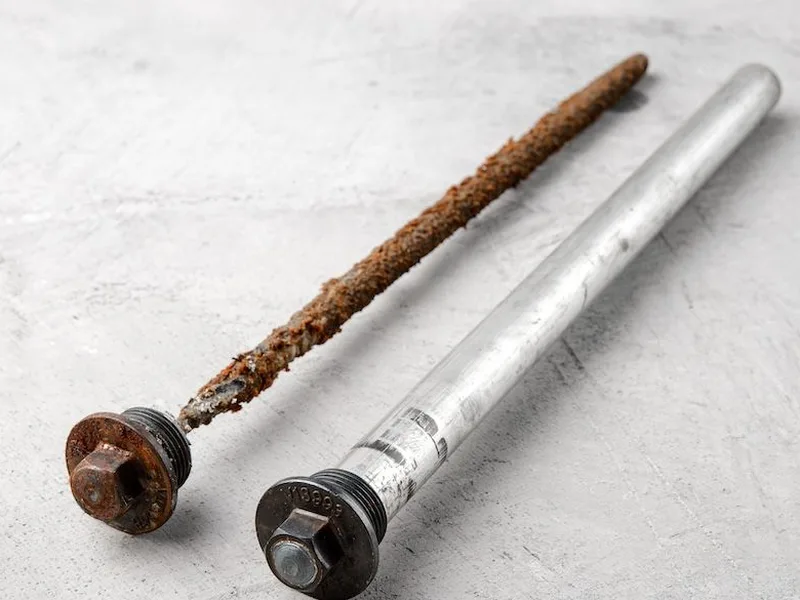
Deep inside your water heater sits a long, unassuming metal rod that does more to extend your tank's life than almost any other component. That is the anode rod, sometimes called a sacrificial anode, and it exists for one reason: to rust so your tank does not have to. Understanding what it does, how long it lasts, and when to replace it is one of the smartest things a Diamond Bar homeowner can do to avoid a sudden leak and an emergency replacement bill.
What the Anode Rod Actually Does
A standard tank water heater holds forty or fifty gallons of water inside a steel tank coated with a thin layer of glass. That glass lining protects the steel from constant contact with water, but it is not perfect. Tiny cracks and imperfections are inevitable, and where bare steel touches water, corrosion begins. The anode rod stops that corrosion through a simple electrochemical trick. The rod is made from a metal that corrodes more easily than steel — usually magnesium or aluminum — so corrosive reactions in the tank attack the rod first. In effect, the rod sacrifices itself so the tank survives. Once the rod is consumed, though, corrosion turns its full attention to the tank walls, and that is when rust patches, pinhole leaks, and tank failure begin.
This is why plumbers treat the anode rod as the single most important wear part in a storage water heater. A tank with a healthy anode rod can last well beyond a decade. A tank whose rod dissolved years ago and was never replaced can fail in as little as five or six years, especially in areas with mineral-heavy water like much of Southern California.
How Long Does an Anode Rod Last?
Most anode rods last between three and five years, but that range swings widely depending on water chemistry, usage, and whether you have a water softener. Homes with softened water chew through anode rods faster because the softening process increases the water's conductivity, which accelerates the electrochemical reaction. Diamond Bar's municipal water supply tends toward moderate hardness, and many households also run water softeners to protect fixtures and appliances — that combination can eat through a magnesium rod in as little as two or three years. A rod in a vacation home with light use might survive six.
The honest answer is that there is no fixed schedule, and anyone telling you every rod lasts exactly X years is guessing. The only reliable approach is to inspect it. Most plumbers recommend checking the anode rod at the three-year mark and then annually after that. Inspection is straightforward on paper — the rod screws into the top of the tank — but in practice it can be difficult because the factory-installed fitting is often seized tight, and you need overhead clearance to lift a forty-inch rod out of the tank. For many garage or closet installations, a flexible segmented replacement rod is the practical answer.
Signs Your Anode Rod Needs Replacing
Your water heater will not flash a warning light when the anode rod is spent, so you have to watch for indirect clues. Here are the most common ones:
- Rotten-egg smell in hot water only. A depleted magnesium rod can react with sulfate bacteria in the water to produce hydrogen sulfide. If the odor appears only in hot water, the anode rod is the prime suspect.
- The rod is visibly consumed. During inspection, if the rod has shrunk to less than half an inch of diameter, or the steel core wire is exposed over long stretches, it is done.
- The tank is past the five-year mark and the rod has never been checked. Statistically, a rod in continuous residential use is largely spent by year four or five.
- Rust-colored hot water. This can mean tank corrosion has already started because the rod failed long ago — at this point replacing the rod will not save the tank.
- The heater is noisy. Indirect, but sediment and corrosion often advance together, and both shorten tank life.
Replacing the Anode Rod Step by Step
If you are handy and the installation allows, replacement is a manageable DIY job. Start by turning off the water supply to the heater and, for safety, shutting off the fuel or power. Gas heaters go to pilot or off; electric heaters get disconnected at the breaker. Relieve tank pressure by opening a hot water faucet somewhere in the house and testing the temperature-and-pressure relief valve. Locate the anode rod hex fitting on top of the tank — some models hide it beneath a plastic cap. Use a 1-1/16-inch socket and a breaker bar to loosen it; these fittings are factory-torqued and stubborn. Wrap the new rod's threads with Teflon tape, thread it in by hand first to avoid cross-threading, then tighten firmly. Refill the tank completely before restoring power or gas — an electric element exposed to air will burn out in seconds.
One practical note for California garages: if overhead clearance is tight, buy a flexible segmented rod that bends as it drops in. It costs a little more than a solid rod but installs anywhere a standard rod cannot fit. If the fitting will not budge, do not force it to the point of rocking the tank off its earthquake straps or stressing the plumbing connections — call a professional rather than risk damage.
Choosing the Right Replacement Rod
You will see three main types on the shelf. Magnesium rods offer the strongest protection and are the best choice for most homes. Aluminum rods last longer and suit very hard water, but they can produce more sediment over time. Aluminum-zinc alloy rods are the go-to fix for persistent rotten-egg odor, because the zinc suppresses the bacteria that cause the smell. If smell has been a recurring problem in your home, the alloy rod is worth the small premium. For any rod, match the length to your tank and keep the old rod for comparison.
Powered anode rods are a newer option worth knowing about. Instead of sacrificing metal, they use a small electrical current to suppress corrosion, and they never need replacing. They cost more upfront but can be a smart investment for a new high-quality tank you plan to keep for fifteen years.
Anode Rod Replacement vs. New Water Heater
A fresh rod costs a fraction of a new water heater, and on a tank under eight years old with no signs of rust, replacement is almost always the right move. But there are limits. If the tank itself is rusting — discolored water, visible corrosion at the base, or dampness around the bottom — a new rod cannot reverse that damage. Likewise, if the heater is more than ten years old and has never had a rod change, the tank has been corroding unprotected for years, and putting a new rod in is like locking the barn after the horse has gone. In that situation, plan for replacement and have a pro assess the timeline.
Diamond Bar Water Chemistry and Your Anode Rod
Not all tap water treats anode rods equally, and Diamond Bar's supply has its own personality. Much of the city's water arrives as imported blends delivered through regional wholesalers — a mix of Colorado River and State Water Project sources — which tends to land in the moderately hard range. That mineral content is not extreme, but it is steady, and steady mineral exposure is exactly what shortens anode rod life a year or two below the national average.
The bigger local variable is the water softener. A large share of Diamond Bar households run softeners to protect fixtures, dishwashers, and tankless units from scale. Softened water is more conductive, which speeds up the electrochemical reaction the anode rod depends on. In practical terms, a magnesium rod that might last four or five years in unsoftened water can be down to a stub in two to three years once a softener is in the picture. If your home has a softener, treat the three-year inspection as mandatory rather than advisory — and consider an aluminum-zinc alloy rod at replacement time, since it holds up better in softened water and also suppresses the rotten-egg odor that softener homes sometimes develop.
Homes on the city's hillier streets sometimes notice slightly different water behavior than homes down in the flatter tract neighborhoods, simply because pressure zones and pipe runs differ. The anode rod does not care about your elevation, but your pressure does affect how aggressively water moves through the tank, and higher pressure plus softened water is the fastest combination for rod consumption. If you know your home runs high static pressure, that is one more reason to check the rod early.
Powered Anode Rods: Worth It for Diamond Bar Homes?
A powered (impressed-current) anode rod works differently from the sacrificial rods described above. Instead of dissolving to protect the tank, it uses a small electrical current from a wall outlet to suppress corrosion. It never needs replacing, which makes it attractive for homeowners who do not want to think about anode schedules at all.
For Diamond Bar, powered rods make the most sense in two situations. The first is a softener household with a newer, high-quality tank you plan to keep for fifteen years — the powered rod eliminates the two-to-three-year replacement cycle softened water forces on sacrificial rods. The second is a home with chronic rotten-egg odor that keeps returning after alloy rod swaps; powered rods do not feed the sulfate-reducing bacteria that cause the smell the way magnesium does. The trade-offs are upfront cost, which runs several times a sacrificial rod, and the need for a nearby outlet plus a small ongoing power draw. On an older tank with unknown internal condition, a powered rod is not a rescue device — it protects, it does not repair.
A Practical Inspection Schedule for Diamond Bar Homeowners
Here is a schedule that fits local conditions rather than generic advice:
- Year 1–2: No anode action needed on a new tank. Use this time to learn your setup — where the rod fitting sits, whether you have overhead clearance, and whether your water is softened.
- Year 3: First inspection. This is the single most valuable check. If the rod is more than half consumed at year three, your water is aggressive and you should plan on a two-to-three-year replacement rhythm.
- Year 4–5: Replace if the first inspection showed heavy wear. If the rod looked healthy at year three, inspect again at year five.
- Year 6+: Annual inspections. By this point the tank's glass lining has aged and the anode is doing heavier duty. Pair the check with your annual flush — the tank is already being serviced, so the incremental effort is small.
One honest caveat: inspection requires breaking loose a fitting that the factory torqued hard, and on many Diamond Bar garage installations the rod cannot be lifted out without hitting the ceiling. A flexible segmented rod solves the clearance problem, and a pro with an impact wrench solves the seized-fitting problem in minutes. If either obstacle stops your DIY inspection, do not skip the check — schedule it as part of a maintenance visit instead.
If you are unsure about your tank's condition, our team at Water Heater Leak Repair Masters can inspect the anode rod and the tank during the same visit and give you a straight answer about whether replacement makes sense or a new unit is the smarter spend. Call (833) 713-2101 for water heater help anywhere in Diamond Bar, CA.