Professional Service
The gas control valve is the brain of your gas water heater — the component that decides when the burner fires, how much gas it gets, and when to shut everything down for safety. It houses the thermostat, the pilot controls, and the safety shutoff in a single assembly, which means when it fails, the symptoms are unmistakable: a pilot that will not stay lit, a burner that never fires, or no hot water at all. Because this part meters natural gas, it is not a component for guesswork or do-it-yourself experiments. Gas control valve replacement in Diamond Bar, CA 91765 demands careful shutoff procedure, correct valve selection, proper thread sealing, and rigorous leak testing before the heater goes back into service. Our team performs this replacement regularly on every major brand of gas water heater, and every job ends with a full safety check of the venting, connections, and operation. If your gas heater has gone cold and the pilot will not cooperate, call (833) 713-2101 and let a professional handle the gas.
What the Gas Control Valve Does
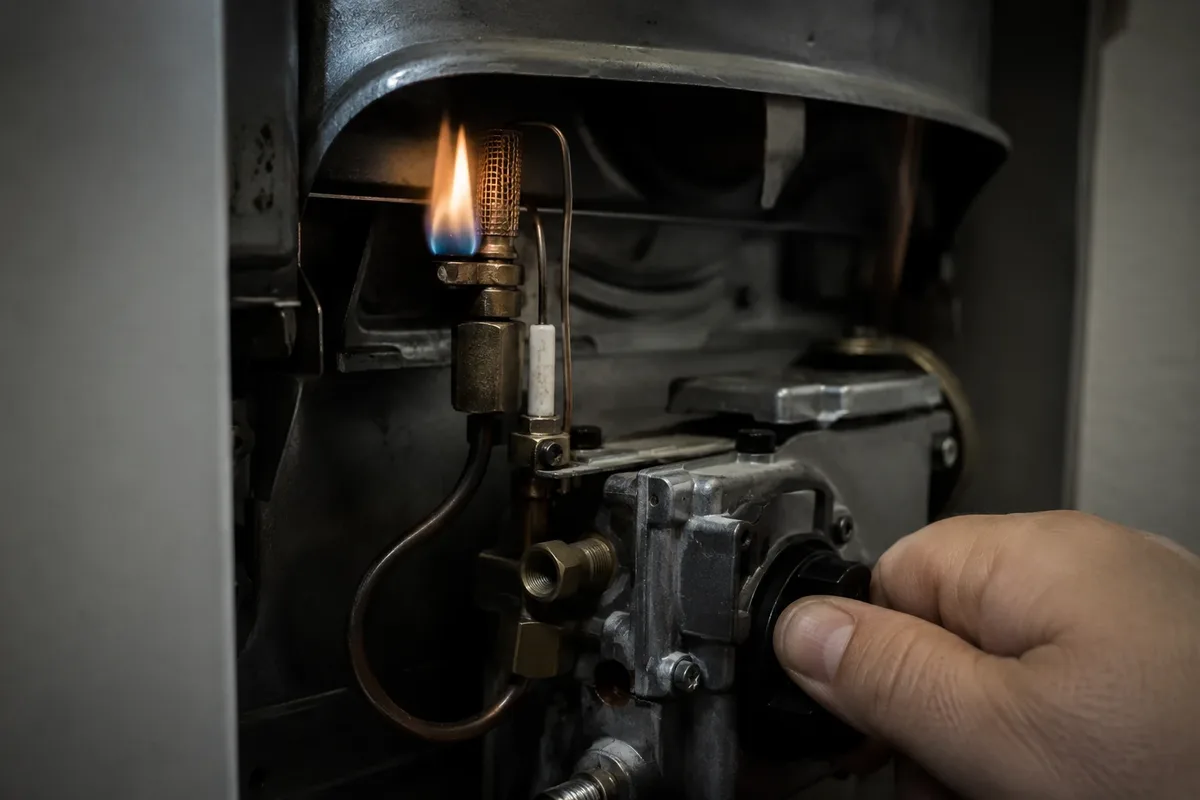
On a gas water heater, three jobs that would be handled by separate parts on an electric model all live inside one brass assembly: the gas control valve. First, it is the thermostat — a temperature probe extends from the valve into the tank, and the valve opens or closes the gas supply to the burner to hold your set temperature. Second, it is the pilot control, managing the small standing flame (or the ignition sequence on newer models) that lights the main burner. Third, and most importantly, it is the safety shutoff: if the pilot goes out, the valve is designed to stop gas flow rather than let unburned gas accumulate. That triple duty is why valve problems show up as heating problems — the valve is the gatekeeper between your gas line and your hot water.
The valve does not work alone. It partners with the thermocouple or thermopile, a small sensor that sits in the pilot flame and generates a tiny electrical current as long as the flame is present. That current holds the valve's safety magnet open; lose the flame, lose the current, and the valve snaps shut. It also works with the burner assembly and, on many models, a thermal cutoff switch that kills the pilot if flue temperatures climb too high. Understanding this partnership matters for diagnosis, because a pilot that will not stay lit can be a dead thermocouple, a clogged pilot orifice, a tripped thermal switch — or a valve whose internal magnet or gas passages have failed. Each has a different fix and a different price, which is why proper testing beats parts-swapping every time.
Valves fail for ordinary mechanical reasons: internal diaphragms stiffen with age and heat, gas passages varnish up, thermostat calibration drifts, and safety magnets weaken. The average valve gives ten to fifteen years of service — roughly the life of the heater it serves — but hard water scale, excessive heat, and gas supply contaminants can shorten that. When a valve starts failing, it rarely fails all at once; it fails intermittently at first, with the pilot dropping out on windy days or the burner cycling oddly, before giving up entirely. Those intermittent symptoms are the warning window. Calling for diagnosis during that window is the difference between a planned valve replacement and a cold-shower emergency.
Symptoms of a Failing Gas Control Valve
The signature symptom of a failing gas control valve is a pilot light that will not stay lit no matter how carefully you follow the relighting instructions. You hold the pilot button, the flame catches, you release — and it dies. When the thermocouple, pilot orifice, and thermal switch all test good but the pilot still will not hold, the valve's internal safety magnet or gas circuit is the prime suspect. A second classic sign is a burner that never fires even though the pilot is lit and the thermostat is calling for heat: the valve is receiving the demand signal but cannot open the main gas passage.
Symptoms that point to the gas control valve
- Pilot lights but goes out the moment you release the pilot button
- Pilot stays lit but the main burner never ignites
- Water temperature swings wildly or never reaches the thermostat setting
- Burner cycles on and off rapidly without satisfying demand
- Visible damage, corrosion, or gas odor around the valve body
- Heater is over ten years old with original valve and declining performance
Temperature problems deserve special attention. A thermostat section that has drifted out of calibration can run the tank far hotter than the dial setting — scalding water from the tap is a safety issue, not just a comfort one — or leave you with lukewarm water while the dial insists everything is fine. Any smell of gas around the valve body itself is an immediate red flag: shut off the gas supply to the heater, ventilate, and call for help rather than investigating. And if your heater uses a newer electronic ignition instead of a standing pilot, failure symptoms shift toward error-indicating LED blinks and a burner that attempts ignition repeatedly without catching — the valve's ignition circuitry rather than its pilot magnet, but the same professional replacement applies.
Why Gas Valve Work Demands a Professional
There is a bright line in water heater work between what a handy homeowner can tackle and what belongs to a professional, and anything that meters natural gas sits firmly on the professional side. Replacing a gas control valve means breaking into the gas line: shutting off supply, disconnecting the gas piping, removing the valve from the tank, installing the new one with proper thread sealant rated for gas, reconnecting the pilot and thermocouple lines, and then — critically — pressure-testing every joint for leaks before the heater fires. A missed leak at any of those joints fills an enclosed space with combustible gas. The stakes are simply too high for trial and error, and no online video changes that arithmetic.
Correct part selection is the second reason this is professional work. Gas valves are not universal: they differ by thread size, temperature probe length, BTU rating, pilot configuration, and ignition type, and installing the wrong valve can leave the burner starved, overfired, or unsafe. We identify the exact valve your model requires — or the manufacturer-approved superseding part when the original is discontinued — rather than forcing a close-enough fit. Venting gets checked too, because a valve replacement is the ideal moment to verify the flue is drafting properly; a perfectly installed valve on a poorly venting heater is still a carbon monoxide risk.
The third reason is what happens after the wrench work: verification. A professional replacement ends with the gas joints tested under pressure, the pilot lit and observed through several cycles, the burner firing pattern checked, the thermostat verified against actual water temperature, and the area rechecked for any trace of gas. That commissioning sequence is what turns a parts swap into a safe repair. Our Diamond Bar technicians perform it on every gas control valve replacement, and we document the results for you. When the job involves gas, thorough is not optional — it is the entire point.
Our Gas Control Valve Replacement Process
Our gas control valve replacement follows a strict safety-first sequence. We begin with a full diagnostic to confirm the valve is actually the problem — testing the thermocouple output, checking the pilot assembly, and verifying the thermostat's behavior — because replacing a good valve wastes your money and leaves the real fault in place. Once the valve is confirmed as the failure, we shut off the gas supply at the heater's service valve, turn the control to off, and shut off the cold-water inlet. The tank is drained below the valve port so the temperature probe can be withdrawn without a flood, and the work area is ventilated.
The old valve comes out next: gas piping disconnected, pilot tube and thermocouple lines detached, and the valve unthreaded from the tank. We inspect the tank threads and the probe port, clean them, and install the new valve with gas-rated thread sealant, torqued to specification. The gas piping, pilot assembly, and thermocouple are reconnected, and then every gas joint is tested for leaks under pressure — twice, by two methods — before anything is lit. Only with zero leaks confirmed do we relight the pilot, verify it holds through the thermocouple circuit, and fire the main burner.
Commissioning is where the job earns its keep. We observe several full heating cycles, confirm the burner lights smoothly and shuts down crisply at the set temperature, and check actual delivered water temperature against the thermostat setting. The flue is checked for proper draft, the area is swept once more for any trace of gas, and the TPR valve and surrounding connections get a leak inspection while we are there. You get a heater that fires reliably, holds temperature accurately, and has been verified safe — plus a clear explanation of what failed and what to watch for. For gas control valve replacement done right in Diamond Bar, call (833) 713-2101.