Professional Service
Tankless water heaters have earned their popularity in Diamond Bar — endless hot water, a fraction of the space, and no forty-gallon tank waiting to rust through. But tankless units can leak too, and their leaks follow different rules than tank leaks. With no stored water, a tankless leak comes from the heat exchanger, the water connections, the condensate system, or the pressure relief valve — and in Diamond Bar's hard-water territory, scale is the prime suspect behind most of them. Mineral buildup insulates the heat exchanger, creates destructive hot spots, and stresses joints until they weep. Our tankless water heater leak repair service in Diamond Bar, CA 91765 covers every major brand, from diagnosis with error-code analysis and pressure testing through repair, descaling, and component replacement. From routine descaling to heat exchanger repair, we handle the full range of tankless service. Call (833) 713-2101 for tankless specialists who understand these units inside and out.
How Tankless Leaks Differ From Tank Leaks
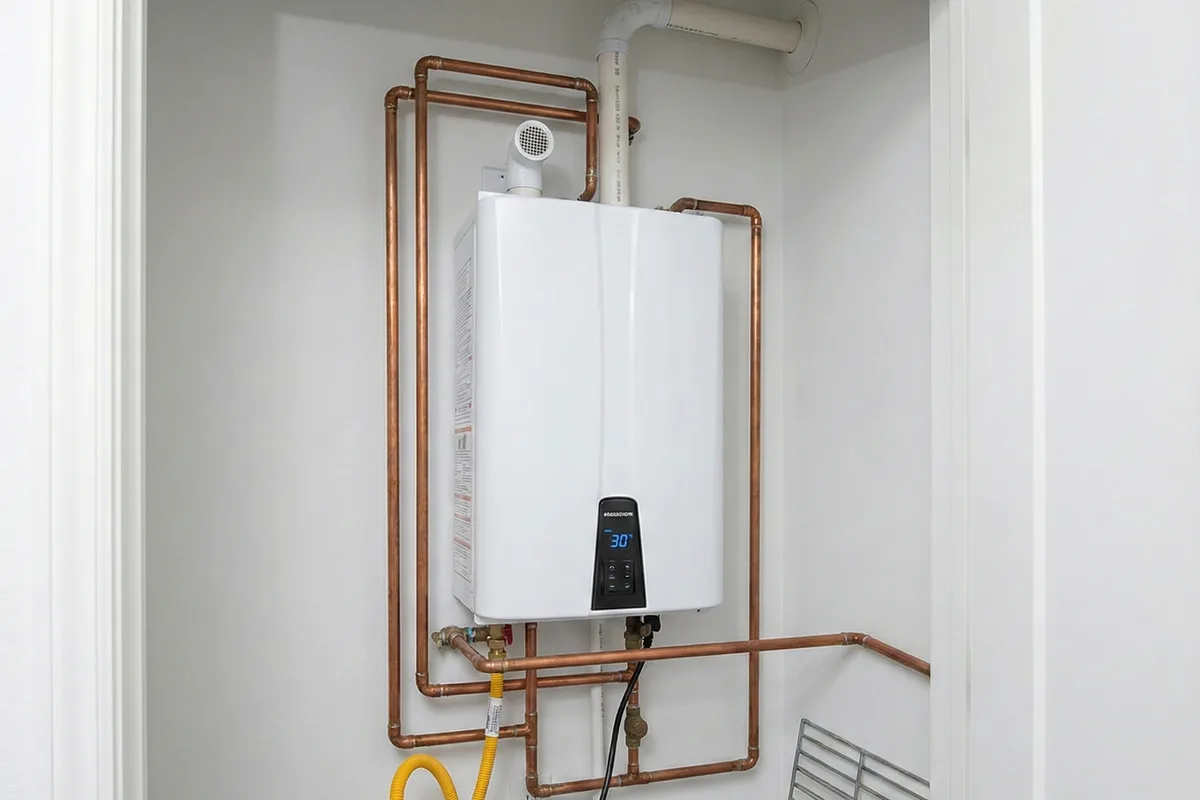
A tankless water heater contains no stored water, which changes the entire character of its leaks. There is no tank to rust through and no forty gallons waiting to flood — instead, water moves through a compact heat exchanger, a maze of copper or stainless tubing wrapped around a powerful burner, and every leak is a breach somewhere in that pressurized path. The most consequential leak point is the heat exchanger itself: pinholes from scale-induced hot spots, stress cracks at bends, or failed braze joints. These leaks often start as intermittent seeps that appear only when the unit is firing and under full thermal stress, then vanish when it cools — which makes them maddening to catch without systematic testing.
The connection points are the next most common sources. The cold-water inlet and hot-water outlet fittings, the isolation/service valves if installed, and the pressure relief valve all live under constant pressure and thermal cycling. In Diamond Bar, where many tankless units were installed during remodels with varying workmanship quality, we regularly find leaks at threaded adapters that were never quite right — slow seeps that have been mineral-crusting for years before anyone noticed the dampness. Condensate is the sleeper source on high-efficiency condensing units: these models extract so much heat that water vapor in the exhaust condenses, and that acidic condensate must drain freely. A clogged or improperly routed condensate line backs up and overflows, looking exactly like a water leak while the heat exchanger is perfectly sound.
Diagnosis has to account for all of this, which is why tankless leak repair starts with the unit's own testimony: the error code history. Modern tankless units monitor flow, temperature, ignition, and venting, and their codes often point directly at the distressed subsystem. We combine code analysis with visual inspection under firing conditions, pressure testing of the water path, and condensate line verification. Guessing at tankless leaks is expensive — the parts are pricier than tank-heater parts and the labor more specialized — so methodical diagnosis is not a luxury here. It is the only economical way to fix these units, and it is how our Diamond Bar tankless service operates on every call.
Common Causes of Tankless Leaks in Diamond Bar Homes
In Diamond Bar, the story behind most tankless leaks can be told in one word: scale. The local water's dissolved minerals precipitate inside the heat exchanger every time the unit fires, plating the water passages with an ever-thickening crust. That crust insulates the metal from the water it is trying to heat, so the burner-side surface runs far hotter than designed — creating thermal stress, hot spots, and eventually the pinholes and cracks that become leaks. A tankless unit that has gone years without descaling in Diamond Bar is essentially running a chemistry experiment on its own heat exchanger, and the results are predictable. This is why manufacturers specify descaling intervals and why ignoring them voids the protection you thought you had.
Installation quality is the second major cause we encounter. Tankless units demand precise gas sizing, correct venting, proper condensate routing, and solid water connections — and shortcuts in any of these become leaks or failures downstream. Undersized gas lines starve the burner, causing rough combustion that stresses the exchanger. Improperly sloped condensate lines back up. Over-torqued or under-sealed water fittings weep from day one, then crust over and hide for years. We see these legacy issues disproportionately in units installed during quick flips or by generalists rather than water-heater specialists, and part of our repair visit is correcting the underlying installation defect so the leak does not simply recur.
Freeze damage, though rare in Diamond Bar, deserves a mention for units mounted on exterior walls or in unconditioned spaces — one hard freeze night can split an exchanger. More common is simple age: heat exchangers live brutal thermal lives, cycling from ambient to hundreds of degrees thousands of times, and after fifteen-plus years metal fatigue becomes a legitimate leak source. Whatever the cause, our approach is the same: identify it precisely, fix it completely, and address the conditions that created it — whether that means a descaling regimen, isolation valve installation, or correcting an old installation shortcut.
Our Tankless Leak Diagnosis and Repair
Our tankless leak repair visits follow a diagnostic sequence tailored to these units. We start with the display: current error codes and the stored history, which often identify the distressed subsystem immediately — ignition faults, flow irregularities, overheat events, and venting errors each leave their signature. Then we inspect the unit cold and fire it under observation, watching the heat exchanger, fittings, and relief valve through actual operating conditions, since many tankless leaks only manifest under thermal stress and pressure. Suspect joints get close inspection with the covers off, and the condensate system gets verified independently — line clear, properly sloped, draining freely — because condensate overflow is the great imitator.
Repairs divide by source. Fitting and valve leaks are straightforward: isolate, drain the local section, reseat or replace the fitting, pressure-test. Relief valve issues get the same careful treatment as on tank units, including checking household pressure and expansion control. Heat exchanger leaks require judgment: leaks at serviceable gaskets and accessible joints can be repaired; breaches in the exchanger body call for exchanger replacement or, on older units, full unit replacement — and we price both so you can decide with real numbers. Critically, we descale as part of leak repair when scale contributed to the failure, because repairing a leak without removing the scale that caused it is scheduling the next one.
Every repair ends with a full operational verification: the unit fires, modulates across its range, holds set temperature, shows no codes, and holds pressure at every serviced joint. We also leave you with a maintenance plan sized to Diamond Bar water — descaling intervals, filter checks, and what the display is telling you between visits. Tankless units reward informed owners: a little scheduled attention keeps them efficient and leak-free for twenty years, while neglect turns them into expensive lessons. Our goal on every tankless water heater leak repair call is to fix today's leak and set you up to avoid tomorrow's. If your unit was installed without isolation valves, we recommend adding them during the repair visit, since they make every future descaling faster and cheaper.
Keeping Your Tankless Leak-Free for the Long Haul
Keeping a tankless unit leak-free in Diamond Bar is mostly about respecting what hard water does to heat exchangers. Annual descaling is the cornerstone: a pump circulates food-grade descaling solution through the isolated heat exchanger, dissolving the mineral crust before it can insulate, overheat, and crack the metal. Units with isolation valves make this a clean one-hour service; units without them need valves installed first — a one-time upgrade that pays for itself in every subsequent service. Skipping descaling does not just risk leaks; it silently degrades efficiency as the scale layer thickens, raising gas bills while it shortens the unit's life.
The condensate system on condensing units needs its own attention: the line should be checked for blockages, proper slope, and correct termination, and the condensate neutralizer media — which tames the acidity before drainage — needs periodic replacement. Inlet water filters or strainers, where installed, should be cleaned on schedule; a starved unit works harder and stresses more. And the venting deserves an occasional look: blockages or deterioration change combustion characteristics, which changes thermal stress on the exchanger.
For Diamond Bar homeowners considering the bigger picture, water treatment is worth discussing. A whole-home softener or a scale-inhibition system dramatically slows exchanger fouling, stretching descaling intervals and extending component life — though softeners bring their own maintenance and, on tank units, accelerate anode rod depletion, so the decision deserves a whole-system view. We are happy to talk through the tradeoffs honestly rather than selling equipment. Whether you choose treatment or disciplined descaling, the principle is the same: in hard-water territory, the tankless units that last are the ones whose owners — or whose service partners — stay ahead of the scale. A unit on a regular descaling schedule will run quieter, heat more efficiently, and reward you with years of trouble-free service. Call (833) 713-2101 to put your unit on a maintenance plan that keeps it leak-free.