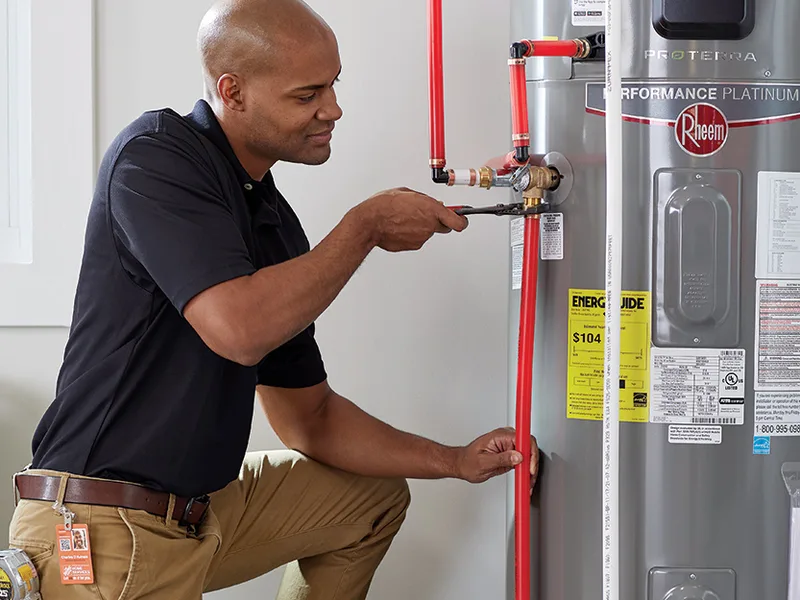
Professional Service
Water heaters sit in an awkward middle ground for DIY: some of their maintenance is genuinely easy homeowner work, while other repairs involve gas lines, 240-volt electricity, or scalding pressurized water — and the line between the two is not always obvious. Do the wrong job yourself and you risk injury, a voided warranty, or a code violation that surfaces at resale. This guide draws that line clearly: what you can safely handle, what you should leave alone, and how to decide when you are unsure.
Safe and Sensible DIY Tasks
These jobs are well within a careful homeowner's abilities:
- Flushing/draining the tank. The classic DIY maintenance task — hose, bucket, patience. Just respect the cool-down and never restore electric power to an empty tank.
- Testing the TPR relief valve. Lift the lever, confirm flow, let it snap shut. If it drips afterward, the valve needs replacing — also DIY-friendly.
- Adjusting the thermostat. Setting it to 120°F is a five-second job with real safety and efficiency benefits.
- Relighting a pilot light. Safe if you follow the procedure and there is no gas smell.
- Replacing the anode rod. Doable when the fitting cooperates and you have overhead clearance; use a flexible segmented rod in tight spaces.
- Insulating hot-water pipes. Foam sleeves, ten minutes, measurable standby-loss reduction.
- Replacing a drain valve. Straightforward on an empty tank during a flush — upgrade cheap plastic to brass.
The common thread: no gas line disassembly, no high-voltage wiring beyond flipping a breaker, and no sealed-system pressure work.
Jobs That Belong to a Professional
Draw a hard line at these. Gas line work of any kind — running new lines, upsizing, repairing leaks, replacing gas valves — belongs to someone trained and equipped for it, and in most jurisdictions it requires permits and inspections. Electrical work beyond the breaker, like wiring a new 240V circuit or replacing elements and thermostats if you are not comfortable with multimeters and lockout procedures, is pro territory for most people. Anything involving the sealed tank itself — and especially anything that tempts you to "patch" a leaking tank — is not a DIY project; a compromised pressure vessel is dangerous. Soldering or pressing new copper connections inside walls, relocating venting, and diagnosing failed control boards or intermittent faults all benefit from professional tools and experience. And any job where you find yourself thinking "this is probably fine" about a gas or electrical connection is a job to hand off.
The Gray Area: Judgment Calls
Some jobs are DIY-possible but pro-advisable depending on your skill and the situation. Replacing heating elements and thermostats on an electric heater is straightforward for anyone comfortable working with 240V safely — test, lock out, verify dead — but if that sentence made you nervous, call someone. Installing an expansion tank is mechanically simple, but the pre-charge must match system pressure and the sizing must be right. Replacing a TPR valve is easy, but if the new one also drips, the underlying pressure problem needs diagnosis. Replacing inlet/outlet nipples or supply lines is fine until corrosion has fused everything together — then the risk of twisting and breaking old pipes rises fast. The honest rule: DIY the task, not the diagnosis. If you are not sure what is wrong, pay for the diagnosis and then decide whether the fix is within your skills.
What DIY Mistakes Cost
The most expensive DIY errors are depressingly common. Dry-firing electric elements by restoring power to an empty tank — instant element death. Cross-threading an anode rod or TPR valve into the tank — damaged tank threads that may not seal again. Overtorquing fittings on old, corroded plumbing — snapped pipes inside walls. Forgetting Teflon tape or pipe dope — slow leaks discovered weeks later. Capping a dripping relief valve discharge instead of fixing the cause — trading a symptom for a potential explosion hazard. And the quietest cost: unpermitted gas or plumbing work discovered during a home sale, forcing expensive corrections under time pressure. None of these happen to careful people who respect the limits — but they happen constantly to confident people who do not.
A Practical Decision Framework
Before you pick up a wrench, run through this checklist: Do I fully understand what is wrong, or am I guessing? Does the job involve gas lines, 240V wiring I am not trained on, or the pressurized tank? Do I have the right tools — not improvised ones? If something goes wrong mid-job, can I make it safe and stop? Is the heater still under warranty, which my work might void? Would a mistake cost more than the service call I am trying to save? If every answer is comfortable, DIY with confidence. If any answer is shaky, that shakiness is your answer — call a professional. There is no shame in it; the best DIYers know exactly where their limits are.
Not sure which side of the line your water heater problem falls on? Call Water Heater Leak Repair Masters at (833) 713-2101 — we will give you a straight answer, and if it is a safe DIY fix, we will tell you that too.