Professional Service
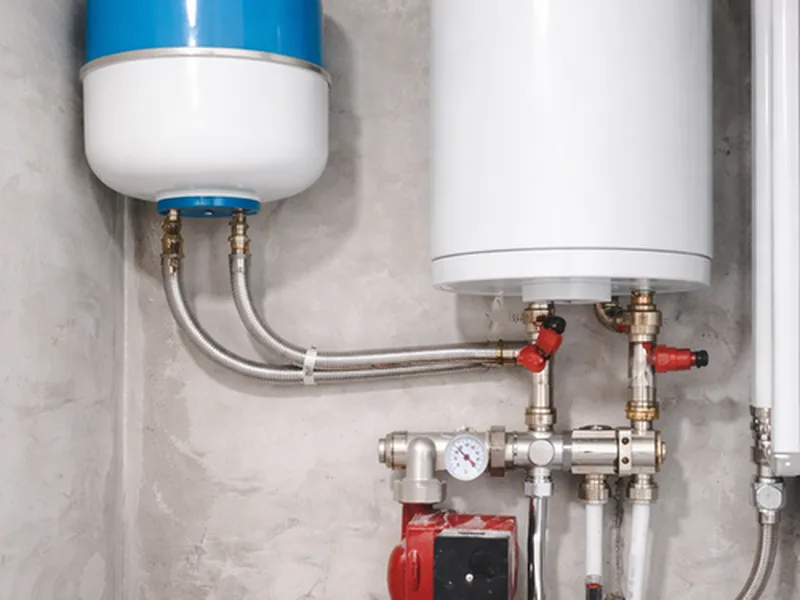
It is a small tank — two to five gallons, often blue or gray — mounted on the cold-water line above your water heater. Many homeowners have never noticed it, and many heaters do not have one. But if your plumbing needs it and it is missing, you will know: the relief valve drips, pressure spikes with every heating cycle, and your plumbing takes a beating it was not designed for. So do you need an expansion tank? The answer depends on one thing: whether your plumbing system is "closed." Here is how to tell and what to do.
Thermal Expansion: The Physics
Water expands when heated — about 2 to 4 percent in volume going from cold to 120°F+. In an open plumbing system, that extra volume simply pushes back out through the cold-water main into the city supply. No harm done. But modern plumbing increasingly includes one-way devices: pressure-reducing valves (PRVs), check valves, and backflow preventers. These create a closed system — water can enter, but it cannot flow back out. Now the expanded water has nowhere to go, so pressure climbs with every heating cycle. Normal residential pressure of 50–60 psi can spike past 100 psi, and repeated spikes stress the water heater tank, flex supply lines, hammer joints, and eventually force the temperature-and-pressure relief valve to open and dump water. The expansion tank's job is to give that extra volume somewhere to go.
How an Expansion Tank Works
Inside the little tank is a rubber bladder dividing it into two chambers: one side holds air pre-charged to match your home's water pressure, the other connects to the plumbing. When heated water expands, the extra volume pushes into the tank and compresses the air bladder — like a shock absorber for your plumbing. When the water cools and contracts, the air pushes the water back out. It is a purely mechanical device with no moving parts to wear out quickly, though the bladder eventually fails (typically after 5–10 years) and the air charge needs periodic checking. That is the entire mechanism, and it is remarkably effective: a properly sized and charged expansion tank essentially eliminates thermal-expansion pressure spikes.
Do You Have a Closed System? How to Check
Look at your main water line where it enters the house. If you see a bell-shaped pressure-reducing valve, you have a closed system — PRVs are one-way devices. Check valves and backflow preventers do the same thing. If you are unsure, there is a simple test: attach a pressure gauge with a "lazy hand" (peak-hold needle) to a hose bib or the water heater drain valve, note the static pressure, then run the water heater through a full heating cycle without using any hot water. If the peak pressure jumps 20+ psi above static, you have a closed system with unmanaged thermal expansion. Many Diamond Bar homes have PRVs because municipal pressure in parts of the area runs high — which means many homes need expansion tanks and do not have them.
Signs You Need One (and Do Not Have One)
- TPR valve dripping after heating cycles — the classic symptom. The valve is relieving expansion pressure, doing its job because the tank is not doing its.
- Pressure gauge spikes — peak readings well above static pressure during recovery.
- Water hammer or banging pipes — pressure waves hitting harder because the system has no cushion.
- Premature failures — supply lines, toilet fill valves, or faucet cartridges failing early from pressure cycling.
- Code requirement — current California plumbing code requires thermal expansion control on closed systems, so a new heater install should include one.
Sizing, Placement, and Maintenance
Expansion tanks are sized to the water heater — a 2-gallon tank suits most 40–50 gallon residential heaters, with larger tanks for bigger heaters or higher pressures. It mounts on the cold-water inlet line, ideally oriented with the connection at the bottom so the bladder does not trap sediment. The critical detail is the air pre-charge: it must match your home's static water pressure (typically 50–60 psi). A tank charged to 40 psi on a 70-psi system is nearly useless; a tank charged above system pressure never engages. Check the charge annually with a tire gauge on the Schrader valve — with the water pressure relieved — and replace the tank when the bladder fails (symptoms: waterlogged tank that feels full and heavy, or expansion symptoms returning). Tap the tank periodically as a quick check: the top should ring hollow (air side) and the bottom sound solid (water side); if the whole tank sounds solid, the bladder has failed.
Think your home might need an expansion tank — or suspect yours has failed? Water Heater Leak Repair Masters installs, sizes, and services expansion tanks across Diamond Bar, CA, and we will test your system pressure to confirm what you actually need. Call (833) 713-2101.