Professional Service
You turn on the hot tap and out comes water the color of weak tea — or worse. Rusty hot water is unsettling, and it raises an immediate question: is my water heater failing? Sometimes the answer is yes. Sometimes the rust is coming from somewhere else entirely, and the heater is innocent. Before you panic or start shopping for a new unit, work through the actual causes. The fix might be a simple flush, or it might be a clear signal that your tank's days are numbered.
First Test: Hot Only, Cold Only, or Both?
This single test narrows the field enormously. Run the cold tap for thirty seconds, then the hot tap for thirty seconds, and compare. If only the hot water is discolored, the problem is inside your water heater or the hot water piping — the cold supply is clean. If both hot and cold are rusty, the issue is upstream: the municipal supply, your main line, or old galvanized cold-water pipes. If the rust appears only at one faucet's hot side, the problem may be that fixture's supply line or the faucet itself. Write down what you observe before you call anyone, because the first question any plumber will ask is exactly this one.
Inside the Water Heater: The Usual Suspects
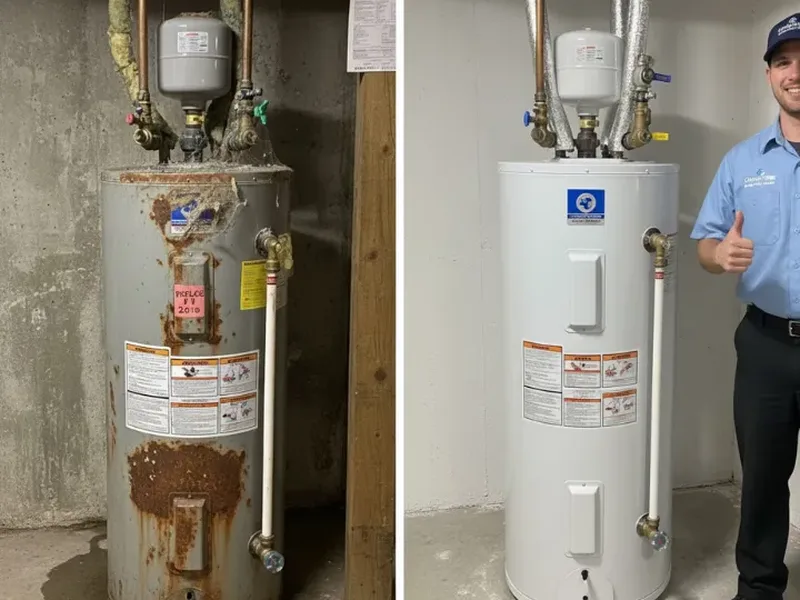
When rust shows up in hot water only, the water heater is the prime suspect, and there are a few specific culprits. The most serious is tank corrosion: the glass lining has failed somewhere, the steel is rusting, and rust particles are mixing into your hot water. This is the beginning of the end for the tank — corrosion does not reverse, and a tank that is rusting internally will eventually leak. The second culprit is a depleted anode rod. The rod's job is to corrode so the tank does not; once it is consumed, tank corrosion accelerates, and rusty water is often the first visible symptom. The third is sediment: years of mineral buildup at the tank bottom can harbor rust particles and stir them up whenever water flows, producing intermittent discoloration that clears after running the tap. The fourth, and least alarming, is rusting inlet or outlet nipples — the short pipe connections on top of the tank. These are replaceable parts, and rust here does not mean the tank is failing.
When the Heater Is Not the Problem
Rusty water is not always the heater's fault. Many Diamond Bar homes built in the 1960s through 1980s still have galvanized steel supply pipes, which corrode from the inside over decades. If both hot and cold water run rusty, or if the discoloration is worst at fixtures farthest from the heater, aging galvanized piping is a strong candidate. Municipal supply issues are another possibility: water main work, hydrant flushing, or a disturbance in the distribution system can send a pulse of rust through the whole neighborhood. If your neighbors have it too and it clears within a day, it was the city supply, not your plumbing. Well water with high iron content produces a similar look but is a water-quality issue rather than a plumbing failure.
Is Rusty Water Dangerous?
Iron rust in drinking water is generally not a health hazard at the levels that cause discoloration — the EPA considers iron an aesthetic contaminant rather than a toxic one. It tastes metallic, stains laundry and fixtures, and looks awful, but it will not poison you. That said, rusty water is a symptom worth taking seriously for a different reason: it signals active corrosion somewhere in your system, and corrosion leads to leaks. Also, if the discoloration is accompanied by an unusual smell, an oily sheen, or symptoms of illness, do not assume it is just iron — have the water tested. When in doubt, a basic water test is cheap and settles the question.
What to Do About It
Start with the easy steps. If the rust clears after running the tap for a minute, flush the water heater to remove sediment — heavy sediment alone can cause intermittent discoloration, and a flush costs nothing but a little time. Check the anode rod; if it is consumed, replacing it can halt further tank corrosion, though it cannot undo rust that has already formed on the tank walls. Inspect the inlet and outlet nipples on top of the tank — if they are the rust source, replacing them solves the problem without touching the tank. But if the hot water stays rusty no matter how long you run it, the tank interior is corroding, and you should plan for replacement. Continuing to use a rusting tank is borrowing time: the rust you see today is the leak you will have tomorrow.
Not sure whether your rusty water means a repair or a replacement? Water Heater Leak Repair Masters can inspect your tank, check the anode rod, and tell you honestly which one you need. Diamond Bar homeowners can call (833) 713-2101 for same-day water heater diagnosis.