Professional Service
When a water heater fails, most homeowners face the same fork in the road: replace it with another conventional tank, or make the jump to tankless? Tankless units promise endless hot water and lower energy bills, but they cost more upfront and are not the right answer for every household. After years of installing and servicing both types across Diamond Bar, here is the balanced comparison we give our own customers — no hype, just the trade-offs that actually matter.
How Each Type Works
A conventional tank heater stores forty to fifty gallons of hot water around the clock, firing its burner or elements periodically to maintain temperature whether you are using water or not. A tankless (on-demand) unit stores nothing; when you open a hot tap, sensors detect the flow and fire a high-powered burner or elements that heat the water as it passes through the heat exchanger. You get hot water within seconds, and it keeps coming as long as the tap is open. The fundamental trade-off is standby versus on-demand: tanks waste energy keeping water hot between uses, while tankless units work much harder during use but idle at near-zero consumption.
Upfront Cost and Installation
This is where tanks win decisively. A conventional tank replacement is a straightforward swap — typically the least expensive water heater project. Tankless installation costs significantly more, and the gap widens on retrofits: gas tankless units often need a larger gas line, a new stainless-steel venting system, and sometimes an electrical outlet for the controls. If your home's gas meter or panel needs upgrading to support the unit, that adds more. For new construction or planned remodels, the cost gap narrows because the infrastructure can be designed in from the start. For a simple like-for-like emergency replacement, the tank is the budget-friendly choice by a wide margin.
Energy Efficiency and Operating Cost
Tankless wins here, though the size of the win depends on your usage. By eliminating standby heat loss, tankless units typically use 25–35% less energy than a conventional tank for the same household — more for small households that use little hot water, less for large families running back-to-back showers and laundry. In real dollars, that usually means meaningful but not life-changing annual savings. Payback on the higher upfront cost typically takes many years, so buy tankless for the endless hot water and the longevity, and treat the energy savings as a bonus rather than the justification.
Hot Water Delivery: Endless vs. Simultaneous
Tankless delivers endless hot water — one shower can run forever. But there is a catch the brochures underplay: flow rate limits. A single tankless unit can only heat so many gallons per minute, and in winter when incoming water is colder, capacity drops. Run two showers plus the dishwasher simultaneously on an undersized unit and everyone gets lukewarm water. Proper sizing for your household's peak simultaneous demand is critical, and in larger homes that can mean a bigger unit or even two units in parallel. A tank, by contrast, delivers its stored gallons at full temperature to as many fixtures as the plumbing allows — until it runs out, and then you wait for recovery. Neither is perfect; they fail in opposite ways.
Lifespan and Maintenance
Tankless units last 15–20+ years versus 8–12 for gas tanks, because there is no stored water corroding a steel vessel. But tankless longevity is conditional on maintenance: in Diamond Bar's moderately hard water, the heat exchanger needs descaling every 12–24 months, or mineral buildup will choke it. Skip descaling and a tankless unit will underperform and fail early — the maintenance is non-negotiable, unlike the "recommended but often skipped" flushing of tank heaters. Tank maintenance is simpler and more forgiving: an annual flush and periodic anode rod replacement.
Space, Lifespan in Practice, and the Verdict
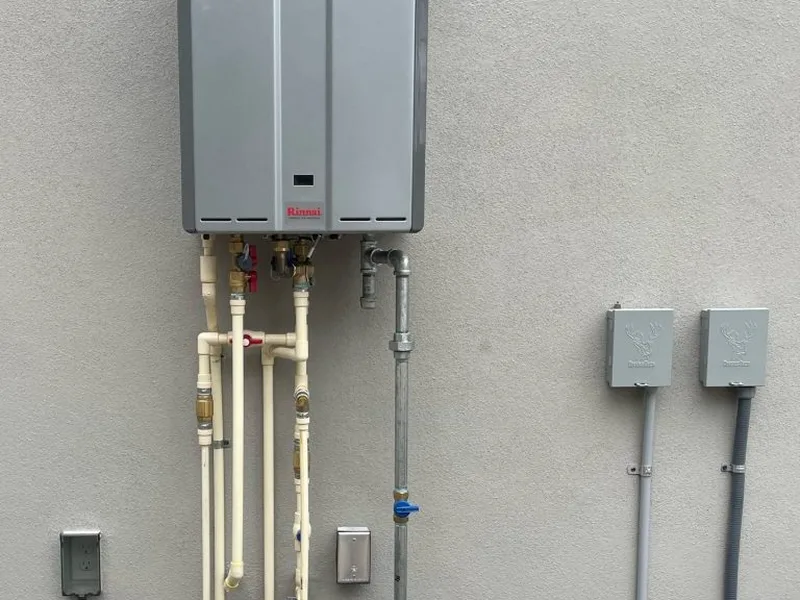
Tankless units mount on a wall and free up significant floor space — a real benefit in tight garages. They also eliminate the catastrophic tank-rupture flood risk, since there is no tank to burst. So which should you choose? Choose a conventional tank if your budget is tight, your hot water needs are modest, your installation is a simple swap, or you plan to move within a few years. Choose tankless if you value endless hot water, want the longest-lasting option, have the budget for proper installation and sizing, and will commit to descaling. Either way, have the unit sized by someone who asks about your actual usage rather than just matching the old unit's gallons. A quick home survey of fixtures, family size, and simultaneous-use habits is all it takes to size either system correctly the first time.
Still on the fence? Water Heater Leak Repair Masters installs and services both tank and tankless systems across Diamond Bar, CA. We will size your options honestly for your household and your budget — call (833) 713-2101.