Professional Service
Not every water heater leak announces itself with a puddle. Many begin as seeps so slow they evaporate before they pool — a damp fitting that dries by morning, mineral crust quietly building on a valve, moisture wicking into drywall behind the heater where no one looks. By the time these hidden leaks become visible, they have often been damaging floors, walls, and framing for months. Professional water heater leak detection in Diamond Bar, CA 91765 exists for exactly this gap between the leak's start and its discovery. Using moisture meters, thermal imaging, pressure testing, and systematic inspection, we find the true source of water intrusion around your heater — distinguishing active leaks from old stains, tank failures from fitting seeps, and real leaks from harmless condensation. Our technicians serve homes across Diamond Bar with same-day appointments and clear, honest findings. Call (833) 713-2101 for a diagnosis you can trust before you pay for a repair.
The Hidden Leaks Most Homeowners Miss
The leaks that cause the most damage are rarely the dramatic ones. A burst tank gets noticed in minutes; a slow seep at a dielectric union can run for a year. These hidden leaks share a pattern: the water volume is small enough to evaporate or absorb rather than pool, so the only evidence is secondary — a white mineral crust forming on a fitting, paint bubbling on the wall behind the heater, a musty smell in the closet, baseboards softening at the edges. In Diamond Bar's warm climate, evaporation works efficiently enough that a meaningful seep can hide indefinitely, damaging as it goes. By the time a homeowner notices, the repair bill often includes drywall, flooring, and mold remediation alongside the plumbing fix.
Certain hiding spots produce most of these cases. Fittings at the top of the heater — inlet, outlet, TPR valve — drip down the tank jacket and evaporate off the warm steel, leaving only crust as evidence. The tank base is another: water seeping from under the jacket wicks into the concrete or flooring beneath, invisible until the rust stain spreads far enough to see. Behind-heater walls absorb slow spray from pinhole leaks in supply piping, showing up as soft drywall months later. And intermittent leaks are the hardest of all: seeps that appear only when the tank is at full temperature and pressure, then vanish as it cools — present during every evening shower, gone by the time anyone investigates in the morning.
Condensation complicates the picture further, because not all dampness is a leak. Cold water entering a warm garage can sweat on the inlet pipe; flue condensation can dampen the tank top; a recently used heater in humid air can mist its jacket. Misreading condensation as a leak leads to unnecessary repairs, while misreading a leak as condensation leads to unchecked damage. Telling them apart requires more than a glance — it requires checking water temperature, timing the dampness against heater cycles, and testing with instruments rather than assumptions. That disciplined differentiation is the heart of professional leak detection, and it is why our Diamond Bar service starts with observation and measurement rather than conclusions.
Our Detection Method and Toolkit
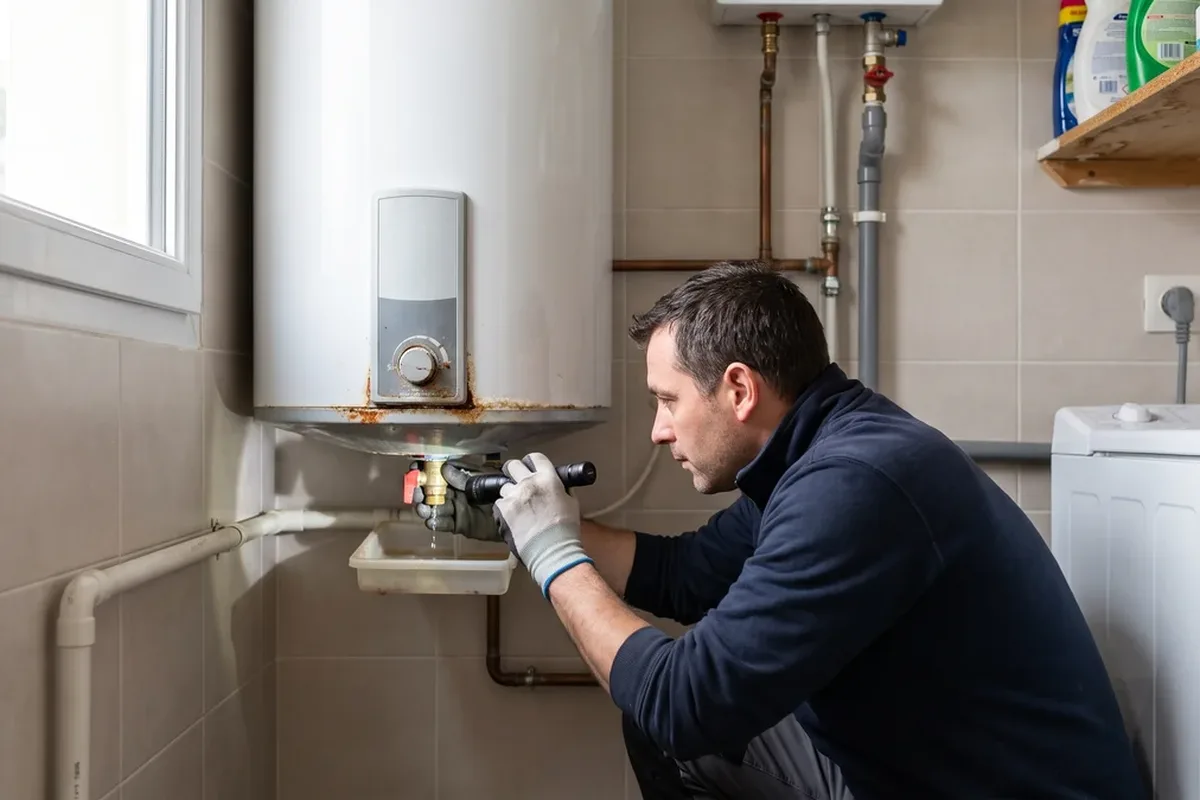
Our detection visits follow a methodical sequence that narrows the possibilities without disturbing your home. We start with the heater running, observing it through real operating conditions — many leaks only manifest at full temperature and pressure, so a cold, static inspection misses them by design. Every connection gets examined in order: inlet and outlet fittings, dielectric unions, the TPR valve and its discharge line, the anode port, the drain valve, element or control ports, and the tank base. We are looking not just for active drips but for the history written in mineral deposits — crust patterns reveal where water has been evaporating, how long it has been happening, and whether the source is above or below each mark.
Instruments extend what eyes cannot see. Pin and pinless moisture meters quantify dampness in walls, baseboards, and flooring around the heater, distinguishing active wetting from old, dried stains by moisture content rather than appearance. Thermal imaging reveals the temperature signatures of hidden moisture — evaporative cooling shows damp areas as cool patterns invisible to the naked eye, letting us trace a wall stain back to its source without opening anything. Pressure gauges verify household static pressure and reveal the thermal expansion spikes that drive intermittent seeps. For ambiguous cases, we use isolation testing: shutting sections down and watching pressure decay to determine whether the loss is at the heater or in the supply piping.
Every finding gets documented and explained in plain language: where the water originates, how long the evidence suggests it has been active, what damage has occurred, and what the repair options are. If the source is a repairable fitting or valve, we can usually fix it on the spot. If it is the tank body, we will show you exactly why and discuss water heater replacement honestly. And if the evidence points away from the heater entirely — to supply piping or an adjacent source — we will tell you that too, and point you toward the right next step. Detection is about truth first; the repair recommendation follows from it.
Leak or Condensation? Telling the Difference
One of the most common outcomes of a leak detection visit is a conclusion homeowners do not expect: there is no leak — it is condensation. This is not a wasted visit; it is the correct answer, and reaching it confidently requires understanding when condensation is normal and when it signals a problem. Cold water entering the tank chills the inlet pipe and the lower tank wall; in a warm, humid garage — a common Diamond Bar installation setting — moisture in the air condenses on those cold surfaces exactly like a cold glass sweats on a summer day. Flue condensation adds another source: combustion gases cooling in the vent can drip back onto the tank top, leaving dampness that looks alarming but is a venting characteristic rather than a plumbing failure.
The distinguishing features are consistent. Condensation forms on cold surfaces — inlet piping, the tank bottom during heavy cold-water intake — and diminishes as the tank heats up and surfaces warm. It produces clear, cool water with no mineral content, leaving no crust when it evaporates. A true leak, by contrast, often leaves mineral deposits, may produce warm water, persists regardless of tank temperature, and typically localizes to a fitting, seam, or valve rather than spreading across cold surfaces generally. Timing matters too: dampness that appears during and after heavy hot-water use and fades between cycles leans toward condensation; dampness that is constant, or that worsens when the system sits pressurized and idle, leans toward a leak.
We verify rather than assume, because the cost of being wrong runs both directions. Calling condensation a leak sells you a repair you do not need; calling a leak condensation lets damage compound for months. Our technicians check surface temperatures, water chemistry traces, and timing patterns before delivering the verdict — and when the answer is condensation, we explain what is normal, what would change that assessment, and the simple steps (like insulating cold piping) that reduce it. An honest negative is one of the most valuable things a detection service can deliver.
From Detection to Repair: What Happens Next
Detection is the beginning of the story, not the end — and what happens next depends entirely on what we find. When the source is a failed component — a drain valve, TPR valve, fitting, or connection — the path is usually simple: we repair it on the spot, verify the fix under operating conditions, and check the surrounding system for related wear. Finding one aged fitting often reveals its neighbors are in similar condition, and addressing them together in one visit is more economical than a series of callbacks. The detection fee folds naturally into the repair visit; you pay for the answer and the fix as one coherent service.
When the source is the tank body itself — a breached seam, pinhole corrosion, rust-through at the base — the honest recommendation is water heater replacement, and we make that case with evidence you can see: the rust patterns, the moisture readings, the location of the breach relative to every fitting. There is no patch or sealant that makes a failed tank trustworthy, and we will not sell you one. What we will do is lay out replacement options promptly, including same-day installation when your situation demands it, so the time between diagnosis and hot water is as short as possible.
And when detection reveals contributing conditions — excessive pressure, failed expansion control, heavy sediment, a depleted anode rod — we address those as part of the complete solution, because fixing the leak without fixing its cause is temporary by definition. Many of our Diamond Bar detection visits end with the homeowner understanding their system better than ever before: what failed, why it failed, and what maintenance prevents the next failure. That understanding is the real product of professional leak detection. To get answers about the water around your heater, call (833) 713-2101.